Opening Doors

photo(62)“The geranium on the windowsill died but teacher you went right on…..”
Albert Callum

The Empire of Mali is a third grade Standard of Learning: Virginia Social Studies 3.2. Mali has a magnificent past.  When the light of learning in Europe dimmed for a time in the Middle Ages, it was burning more brightly than ever in Mali.  The university in Timbuktu provided safe haven for the Latin and Greek texts of fallen Rome. Griots sang epic poetic songs of history and tradition.

Over the years I have developed an integrated unit about Mali that is rich in folktales, history, geography, art, and music.  Many of our American traditions, like the banjo, can be traced back to this part of West Africa.

I teach about Mali every year, but this year it has been hard. Mali is in the headlines.  Mornings begin with a cup of coffee and horrific stories of drought, violence, famine, and fear.  As my children dance to the traditional music of Mali, I think back to an article in the morning’s paper: Mali’s musicians have been silenced and are fleeing for their lives.

As we talk about Griots and their traditional tales of triumph, I can’t help but think of the newly orphaned children whose life stories have been interrupted by loss.  Can I, should I, teach the glorious past of Mali, in the shadow of the current suffering of its people–Without even mentioning it?

How do I open my students’ eyes to the suffering in Mali, and at the same time protect their tender hearts and shield their joy in time of wonder?  My steps on the path of truth-telling must be gentle steps. I lead with the story of The Magic Gourd by Baba Wague Diakite.  The story opens with Brother Rabbit (Dogo Zan) looking for food in a time of drought.  As he searches, he sings a song of hope.  Luck does come his way, but he takes only what he needs and shares it with many.

We’ve learned that drought leads to famine; famine leads to hunger; hunger often leads to a scramble for power; a scramble for power often leads to violence; and violence leads to loss.

When confronted with suffering, children need to know that they are safe.   And then they need to know that they can help.   I have assured them that they are safe and that we can help.  I suggested a bake sale to support a project that would help children in Mali.  They loved the idea and we got right to work.

On Tuesday, just before the P.T.A. meeting, we will have a bake sale to support the Zorkoro Project in Mali. This is a project to expand an orphanage that has a sustainable farm.  You can read more about this project (and even donate) at www.acfacorp.org.

I began this journey with a folk tale.  Once again, a story is our doorway to truth.  And truth is a doorway to change.

Posted in Uncategorized | 4 Comments

Is Less More?

October.    September is gone, proving once again that even a month lived intentionally, day-by-day and hour by hour, will fly by. September is a methodical month.  At the beginning of September, I tell my third graders they don’t have to worry about doing things the wrong way, because I will teach them the right way. September is all about the right way:  Eye contact. Accountable talk.  Intentional chatter. Greeting one another.  Moving through the space respectfully. Showing what you know when you know it and knowing when you don’t.  Thinking deeply.  Breathing deeply. Finding more than one right answer.  Asking better questions.  Widening the circle.  Going the extra mile with a smile.  Stepping forward to help.  Keeping your desk as an invitation to learning. Taking responsibility.  Taking risks.

We learn to read and write “long and strong.” We learn that we will mistakes and we can make them right.   We learn to be mindful of feelings—those of others and our own.  We learn that feelings are not right or wrong… they just are. We learn that sadness fades and that joy waits to surprise us when we least expect it. We see it in literature. We see it in life.

Teachers have answers and live questions.  On Friday I invited my students to live a question with me: How can we make homework better?

My third graders could not have seen the question coming, but they seemed ready for it.  The opinions were strong, but varied, and the results inconclusive.   There was one common thread: Less.  They said less homework would be better homework.  I found myself nodding my head. Their ideas were turning the right way into a better way.

Over the years I’ve worked to create homework that is meaningfully aligned with the classroom.  I’ve been proud of my homework.  It integrates the curriculum and is a springboard for critical thinking. I’ve tweaked it; reworked it; revamped it; revised it. My quest has been to make homework more meaningful.  I think I’ve just made it more.  More may be too much.

The class quickly created a survey.  The children ranked the activities they liked and circled the one they hated the most.

This turned out to be a confusing process—but one thing was clear.  Almost everyone likes the math game.   This doesn’t surprise me. It is good practice, but I also know it is not really about the math. Most children played the game with their parents.  And they love that.

I’m cutting homework back this week.  The essentials are there: a math game, a reading log, vocabulary and spelling, and a little writing.  This week we are living the question.  Together we’ll find the answer.   When it comes to homework, it may be that my third graders are teaching the teacher the right way.

Curious about the new homework?  Click here: Mrs. Campbell’s Homework

Posted in Uncategorized | 5 Comments

I’m Glad You Are Here

They were my first class.  They were first graders and they taught me to notice missing teeth and new shoes.  I remember my first day as their teacher.  I hoped that my students would welcome me, and I hoped that their parents would think that I was grown-up enough to teach their children. I was twenty-one.

It didn’t take me long to realize that it was my job to welcome my students–not their job to welcome me–and my job to assure parents, not the other way around.  Over the years the “first day welcome” has become more and more intentional.  First, it crept beyond the first weeks of September and then it leapt into October.   Now welcome is a way of life in Room 204.

I knew the power of welcome before I learned of the research that backed it up.  The research says that children need to belong, feel safe, and know joy to learn.   This can only happen in a place where children are seen, heard, and invited in.   I knew it before I learned it–that’s  how intuition works. Intuition alone doesn’t trump a textbook or a pacing chart or a lesson plan, but research can.

For three summers I have participated in either the Reading or Writing Institute at Columbia Teachers College with Lucy Calkins.  Lucy’s research puts words to what I know is true.  I know making sure every child has agency as a reader and writer is key to his or her autonomy as a learner and ultimate success as student.   I know it starts with an invitation:  “I have a book that is just right for you.”

My conversations with children work in a teeter totter balance of “Oh, look what you can already do!” with “Get ready, today I’m going to teach you something new.

We are building a community where everybody matters. We are building a common canon of folk tales and stories from many cultures, and with it, a language of literary allusion. We are building trust, so that we can take risks without risking shame. We are building a sense of common purpose in a world that is bigger than ourselves. We are building stamina as readers, writers, and problem solvers.  We are building an academic vocabulary that can deepen our understanding of all that we learn. And we don’t have time to waste.

We are learning to open our arms wide to the world.  It all starts in a doorway with an outstretched hand and it grows within a circle of trust. Teaching is a radical act of hospitality. “Welcome.” I smile and I tell the truth:  “I am glad you are here.

Posted in Uncategorized | 10 Comments

Guarding Fragility

Whether we are conscious of it or not, we think and speak in metaphor.  Metaphor is the picture language that lays track from heart to mind and back. Metaphor stirs the imagination and helps us mix what we learn with what we know.  Sometimes metaphor sneaks up from behind, “Boo! You didn’t find me, I found you!”  It grabs us and won’t let us go.

In February our third grade class started watching the Richmond Times-Dispatch “eagle cam.”   We would check in and see how the parents, Virginia and James, were faring.  We loved to watch the way they took turns sitting on the nest.  We were thrilled to get a glimpse of the eggs during the “shift changes.”  We watched them repair the nest with care.  Twig by twig. We were mesmerized by the “real time” miracle that could not and would not be rushed.

At the end of February it snowed. Virginia, the mother eagle, weathered the storm and never left her eggs.  Day and night she quietly sat guarding the fragile potential–her life’s work.  In our third grade community, we began to feel like we were sitting on the nest.  In March we watched the eggs hatch.  We watched the mother and father feed their chicks.  We held our breath when they were left alone and cheered when an intruder was chased away.

As spring came, we found more nests.  Osprey nests. Robin nests.  Cardinal nests.  One day, as we walked, we found a broken blue egg with a yolky interior: a sad reminder that miracle and fragility walk hand in hand.

In May, the eaglets practiced and practiced and practiced flapping their wings.  They took all the time they needed. One needed more than the other… and it wasn’t the one we would have predicted.   Last week, when they were ready, they flew– first one then the other.

It is June.  In the midst of celebrating college and high school graduations and weddings of former students of Room 204, I am now bracing myself to say good-bye to this group of third graders. They’ve been talking about how happy and sad they are at the same time. I tell them those are the feelings of getting ready to leave. They are flapping their wings. When they leave they will soar. They are ready.  Off they’ll go.  I will stay.

There are storms that threaten the nest.  “Reform” is a storm that threatens the infrastructure that was begun by the true school reformers a hundred years ago. John Dewey was passionate about public schools as centers for experiential learning, shared inquiry, and informed citizenry.  Could he have foreseen the day when an informed citizenry would say no to extra money for schools? People often forget that the “tough on schools” almost always translates to  “tough on teachers and children.”   Sadly, I am not surprised that citizens would overlook a cut in pay and benefits to teachers.  I am surprised, however, that people are okay with increased class size.   I had a brief conversation with Arne Duncan (Secretary of Education) earlier this year.  I implored him to consider the importance of class size.  He responded that good teachers are more important than class size.

Here is the truth: every child deserves a good teacher AND a reasonable class size that supports and encourages his or her class participation. We can teach our children to flap their wings, but conditions have to be just right for them to fly.  Public education is a precious part of our nation’s infrastructure. It has been built twig by twig and is in constant need of repair, refining, revision, and yes, reform. True reform, like education, is a real-time miracle that cannot be rushed.   It isn’t that we’ve gotten it wrong.  It is that we are still working on getting it right. Miracle and fragility walk hand in hand.   Good teachers (and there are plenty) guard the fragility and bet on the miracle.

This is the week that I celebrate the 19 miracles before me, my students.  On Friday I will say good-bye to each of them.  I have loved being their teacher and I will miss each of them.  Experience has taught me this:  I will also love watching them soar.

Posted in Uncategorized | 4 Comments

Words Matter

My class and I are coming to the end of Charlotte’s Web. O Charlotte.  You.  You’re the one. You are the greatest heroine in Children’s Literature.

I can make such a bold statement with veracity (she would approve of that word), because I’ve shared this book (and hundreds of others) with many classes over the last thirty years.  I’ve read Charlotte’s Web to first graders.  I’ve read it to second graders.  I’ve read it to third graders. I know her well. This wise book seems most at home in the third grade. E.B. White has a reverence for eight year olds. The book opens with Fern Arable’s voice, “Where is Papa going with that ax?”  Fern is eight.  And she is bold enough to take up for the runt of a litter of pigs with her words.

We sit in a circle. Each child in my class holds a copy of Charlotte’s Web.  We turn the book into a kind of Radio Theater: different children take turns being narrator, while others read the different parts.  We switch it up as we move from chapter to chapter or, sometimes, from page to page.  I always take the part of Charlotte.  Charlotte’s love of vocabulary makes her part a little more difficult to read, but that isn’t the only reason I take her part … I read Charlotte to make sure her strength and beauty and encouraging words wash over my students.

Charlotte understands that everyone has a gift and a role in the balance and beauty of community.  And that everyone desires and is capable of meaningful work. Even Templeton, the disparaged rat, is put to work for Charlotte’s cause.  He ends up with a very important job:  he uses his much maligned scavenger skill to find the right words—words that are perfect enough to save a life.  Charlotte reminds him that the right word will help others see Wilbur’s nobler qualities.  Wilbur matters. Templeton matters.  Words matter.

Words matter in the classroom, too. Our words help children see where they are going—what they can do instead of what they can’t do.  Our words help children see and celebrate their nobler qualities.

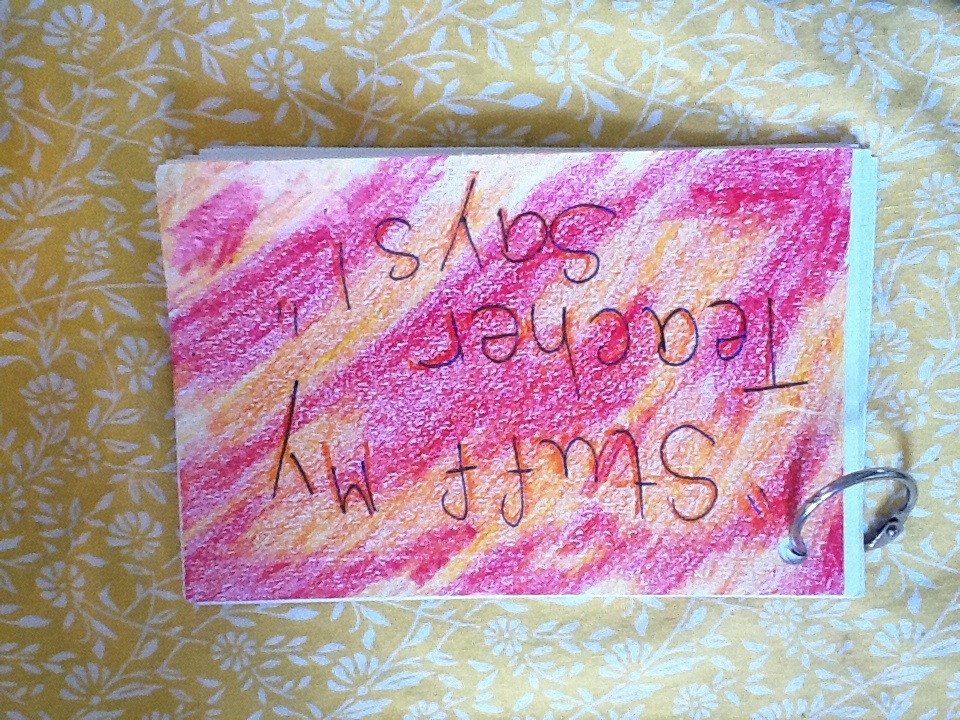
I have been thinking about this important business of words.  What, I wondered, do my students hear when I speak?  What words stick in their heads?  What do they think that I say over and over again?  This led to an idea for a class book and a quick review of quotation marks.   I handed each child an index card.  In five minutes our book was done.

“Be kind, fair, and responsible, says Mrs. Campbell.

“Put like with like,” said Mrs. Campbell.

“Getting started is half the battle,” said Mrs. Campbell.

“If you want to get done, get started,” said Mrs. Campbell.

“Look at the world with the eyes of a writer,” said Mrs. Campbell.

“Make your desk an invitation to learning,” said Mrs. Campbell

“I have 180 days to teach you for life,” exclaimed Mrs. Campbell.

Oh, there were others—those preachy nagging reminders make their way into my teacher-speak, too.   There were phrases about keeping quiet in the hallways and not leaning on the bookcases.

“I only have 180 days to teach you for life,” said Mrs. Campbell.

Peter Johnston in his amazing book, Choice Words, reminds us that our choice of words has the power to  increase children’s agency as readers, writers, and citizens. Our choice of words has the power to  increase a child’s sense of belonging.  Our choice of words has the power to help a child see who they are.  And Charlotte knew that our choice of words can save a life.

We are coming to the end of Charlotte’s Web.  I hear the wren’s song in the roses as she sings in the month of May.  I know what it means.  In the time we have left, I will choose my words carefully. Words matter.

Posted in Uncategorized | 10 Comments

Face First

Writing slows life down and I have been too busy living life to write about it.   I’ve lived it headlong, fully engaged… and, well, face first.

Mrs. Campbell took a tumble,

Mrs. Campbell had a stumble,

Mrs. Campbell tripped on a wall,

Mrs. Campbell had a great fall.

It was a low wrought iron fence (“wall” is poetic license).   In the yearlong study of our school’s city block, we were talking about the land before settlers came.  I was about to read a book about the Native Americans.  It was sunny and hot; I thought I would lead my class to the benches under the magnolia. The only thing between shade and us was a low wrought iron fence.  I asked the children to follow me as I took a shortcut over the fence.  My heel caught and I couldn’t break the fall. My face landed on a mosaic paving stone.

I saw the blood and could hear the concerned murmurings of my third graders. I wanted to reassure them, but I was afraid I would frighten them if I looked up.   I felt my face to make sure my teeth were there.  In a rush of footsteps, like a fluttering of wings, a former parent knelt next to me.  Calm. Soothing. She ran to get help.  Another Fox parent walked over.  He was a doctor. My children stood still as he examined my face.  And then… The principal. The nurse.  Friends.  My husband on the phone.  Ice.

The pain and the swelling and the bruises are gone now, but what I remember a week later is the compassion of my students, their stillness in that moment and their whispered reassurances.  The sweetness of their young courage stays with me.

Writing slows down the moment and helps us live (and walk) mindfully.  I’ve been too busy to write.  But there is a deeper lesson here. Last week David Brooks wrote in the New York Times about learning and relationship. In his March 22 column, he said:

“Since people learn from people they love, education is fundamentally about the relationship between a teacher and student.”

Compassion is not accidental.  It is built with relationship. Respectful, reciprocal, and intentional classroom relationships and school communities take time.

My children are outraged that the fence has not been removed,  but of course  it should stay.  It has been there for a hundred years.  And it is a reminder that shortcuts aren’t worth it.

Posted in Uncategorized | 1 Comment

Look Out For Wonder

I used to get in trouble for looking out the window when I was in third grade, but that was a long time ago.

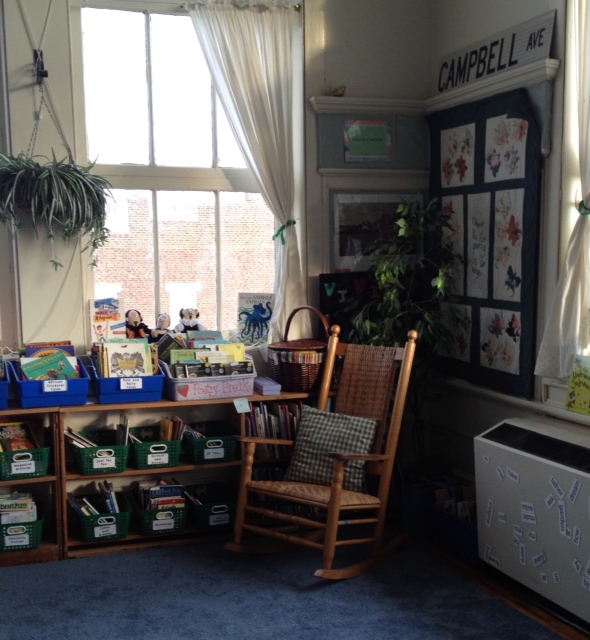
Now I am in a  corner classroom with two walls of windows. And yes, my children look out the windows when they should be working. And no, they do not get in trouble for it. Looking out the window is a reminder that the world is the real classroom. Classroom lessons are seed feed for a bigger world than the four walls of Room 204. No one looks for too long. We maintain an unbroken and unspoken watch. As a long time veteran of looking out classroom windows, I know that sometimes we are looking within as we look out.  Sometimes we look because we know we might see something.  This watch is the “wonder watch” and because of it,  we stumble on surprise.

I’ve discovered  something new with my third grade writers:  shared writing is especially powerful after a shared experience.

“The birds are back!” The children quickly moved toward the windows. We’d researched birds that periodically fill the trees outside our window. We hypothesized the birds were robins. Now here was another flock and this time we were going to find out for sure.

When we came back in the children took out their notebooks and began to write. After they were done, I asked them to share their best “crafty sentence.”  In the bass notes, I heard our mentors (our favorite authors).  I heard a story emerging  and saw the opportunity for shared writing.  Jayvon (my eight year old technology assistant)  quickly opened a word document and projected it on the wall; we went right to work. They shared. I typed. We revised. Only one word is mine; I couldn’t resist adding the word “tentative,” with their permission, of course.

At the end, the children wondered if it could be on the blog.  I can’t think of a better way to get their words out into the world.

We were in the classroom as we noticed birds swarming in the trees.  We put on our coats and went outside.  We waited. We listened.  
“There’s a robin, Mrs. Campbell,” someone said.
“And another,” said someone else.
The wind blew… we walked.   Flocks of beautiful robins sat in trees on Hanover Avenue.  We walked along the sidewalk for a little while. The birds chirped and we made our bird sounds:
”ch,ch…ch, ch, ch….”  
A cardinal came.  We knew it was a male without anyone telling us.   He was a beautiful bright red.
The cardinal flew from tree to tree and off into the cold bright morning.  A flock of birds flew over—they were swirling and circling over our very heads.  
“Mrs. Campbell??”  The girl’s voice trembled.  She was troubled. Tentative.
“Oh, no. This is one of the downsides of birdwatching,” Mrs. Campbell said. “Science…” she added.
“But I don’t like science mixed in with my hair!” said the girl, “Especially not ‘bird science!!’”
Some of us wanted to laugh, but we were afraid we would get in trouble.  Others of us did laugh.  We couldn’t help it.
When we got back to school, we went upstairs, and started to write….

In their writing I am beginning to see (and hear) the countless mini-lessons I’ve taught.  But the truth is– the windows get big credit here.  The story was just on the other side of the glass.

Posted in Uncategorized | 6 Comments

Grow

It was weeks ago, but it stays with me: Grace brought a microscope to school. Usually we have outdoor science on Thursday, but this was Tuesday and the outdoors called us. Earlier, through the windows of Room 204, we’d seen a huge flock of migrating birds arriving in great numbers on the treetops just beyond the roof line across Hanover Avenue.

Now it was late in the day. The birds were gone. Grace’s microscope sat on the round table, still in the box.

“Take out your crayons and look. How many shades of green do you see.” Hands shot up.

“I have a crayon called asparagus,” called one.

“….And I have spring green,” called another.

And forest green.  And yellow green. And just plain green.

“Which crayon would match a blade of grass?  Is all grass the same color?” I asked. We hypothesized about that for a minute. And then we got our coats on and went outside.  Once outside, my third graders waited for instructions.

“Each of you is going to your spot to find a blade of grass. Take a few minutes and come back. You won’t really see if you don’t look.”

Once we had come back together and I asked them to match up with someone with the same color of grass. We went inside to test the hypothesis of color. It turns out that most of our grass was in between two colors. And the color is even more complex when you look under a microscope. Austin pointed out that you could concentrate on a tiny dot that had a color all its own.

Kayia brought me a magnet from the side of my filing cabinet. “Look,” she said. The magnet is a quote from the Talmud: “Every blade of grass has an angel who whispers ‘grow.’”

Isabella came over and told me that her parents had a Johnny Cash song called Forty Shades of Green. We downloaded it on my iphone.

The music  played in the background as the children were grouped around the microscope with their blades of grass.

“What do you see?” I asked.

Colors.  Life.  A tiny egg.

“You know, some people see a field, but writers see a blade of grass.  Your notebook is another kind of microscope. Open up your Quick Writes and write.”

And then… in the whisper of flipping pages, I heard it:

“Grow.”

It is true for teachers, too: You won’t really see it if you don’t look.

Posted in Uncategorized | 12 Comments

One Little Word. One Big Idea.

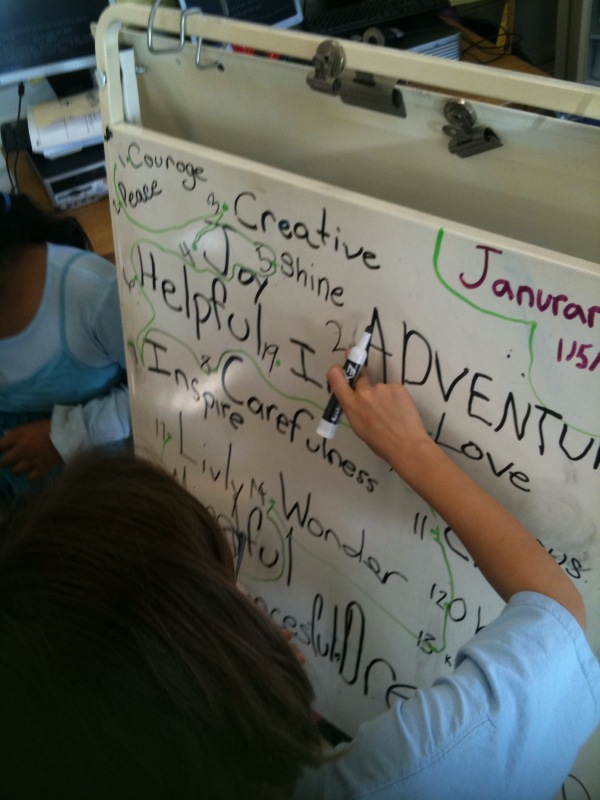
I’d read about the concept of One Little Word on my very favorite teaching blog : Two Writing Teachers.  Stacey and Ruth give credit to Ali Edwards, another blogger.  The idea is this: choose a word to live intentionally for a year.  I like the idea so much more than a New Year’s Resolution. A resolution feels like a stick.  But One Little Word?  That feels like a plumb line. A guide. Grace.

A word landed on me like an errant piece of confetti from the sky.  “Celebration!”  I announced it as soon as I saw it. I wanted my first read-aloud of the year to reflect my word, so I read  I Am in Charge of Celebrations  by Byrd Baylor. I love the poetic language, the graceful use of ellipses and parentheses. I love what it says about noticing, naming, and marking the smallest details of life–seeing how we choose what matters– and knowing if we don’t, we miss it.  Celebration.  Word.  Yes.

I couldn’t wait to call Elizabeth Dunn.  We teach at different schools in Richmond — probably a good thing, because  sparks fly from our heads when our brains get too close.  We have both been participants in the Reading/Writing Project at Columbia Teachers College.  We speak the same language.  We are passionate about our work.  She lives a teaching life that is brilliant and inspired.  And she inspires me.

It was late in the afternoon.  The lights were turned off and setting sun poured its fading color through my classroom windows. I was getting ready to leave.  I called Elizabeth.  “Read this book tomorrow,” I told her.  “It is perfect.”

By Byrd Baylor?  She was very excited about what had happened in her classroom that day, and went on to tell me about it.

She told me that, coincidentally,  she had also read a book by Byrd Baylor to her class that day:  Everybody Needs a Rock.  She told me that  she had chosen One Little Word for herself and thought it would be helpful for her students, too. Then… and this is where her brilliance shines:  She used Baylor’s rules for rock finding to show her children how to find their word.  Each of her students chose a word that was theirs.  And then found a rock to mark the occasion.  We marveled that once again we were on the same track.

I got out the Baylor book as we talked and placed it on my desk while we were still on the phone.  I was ready.

I told her that I had chosen a word, but hadn’t thought of the children choosing a word, too.  It was brilliant!  I shared that my word was celebration.

“Celebration?”  she asked.  “Are you sure? I’m wondering if that is really the word.”  It was a gentle push. We agreed that maybe I needed to pick a word that wasn’t already so much a part of me. I would wait for another piece of confetti to land.

The next morning I read Everybody Needs a Rock to my class in our Morning Meeting.  We talked about rules for finding a word that was our very own.  We sat quietly and  I invited them to gently call out their word, one at a time, as they realized what it was.  There was the confetti again…beautiful words rang out as they fell around us, melting as they hit the ground.  I saw my piece of confetti again, but this time I could see the word more clearly: Mindfulness. Noticing, naming, and marking the smallest details of life–seeing how we choose what matters– and knowing if we don’t, we miss it…  Mindfulness.

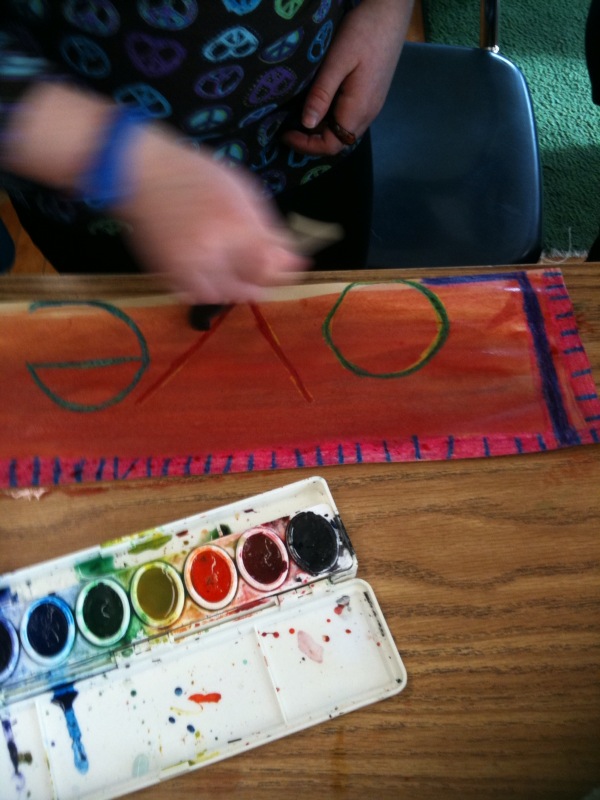
We wrote our little words big in heavy crayon on manila paper.  We painted over them with watercolor and glitter; We saw how each word sparkled and kept shining through.

We wrote about our words.

At the end of the week, Elizabeth and I met at Starbucks to match up our kids as pen pals. This will be our second year doing this. Our kids write each other and then at the end of the year we bring them together for a final writing celebration.  We talked about our words.

She has her one little word and I have mine, but together we keep finding one giant word: Collaboration. It sparkles.  And it keeps shining through.

Posted in Uncategorized | 9 Comments

Tradition: Let’s Do That Again

Tradition loves to be found and, once discovered, it likes to be named to be fully uncovered. This year I found tradition in  carols sung and in the ornaments  hung. Tradition wafted from the kitchen as gingerbread men (and girls)  and Moravian Sugar Cake baked in the oven. Tradition tingled in the bells we jingled as we sang with our baby granddaughter though Skype. Tradition stood with us as we watched the two older granddaughters (one an angel and the other a sheep) in their Christmas pageant on Christmas Eve. Tradition burned brightly and solemnly in the candles we held as we sang Silent Night. Tradition walked with us under the bright night sky that was Bethlehem Blue.

On Christmas Day tradition stood in our circle as four generations joined hands and sang Joy to World. Tradition helped set the table with candy canes, candles, and special Christmas plates.

Tradition is not a tyrant; it bends and evolves and changes to make space for grace. Tradition is a bookmark in the rhythm of life; it marks time or place or story or milestone. It is a way to see something new by returning to the old and familiar. Tradition does not clutter life– it clears the way for the things that really matter. Tradition does not have a religious preference, but it will help live us live faith meaningfully; tradition helps the heart turn holidays into holy days.

Tradition is strong and delicate– a paper chain with links added on or torn away.  Tradition is simple and intricate– a cutout snowflake taped to the window to announce the season. Tradition honors the newly empty chair and helps pull up a new chair to table; it welcomes and it remembers. And it lets go.  Tradition is old practice tailored to new situations. Tradition begins as something new and then waits for our invitation…

“That was fun, let’s do that again.”

“Remember that time? Let’s do that again.”

“That was so meaningful, let’s do that again.”

Today tradition will stand watch as music, cookie cutters, ornaments, and special dishes are carefully packed away.  Tradition stays out of the boxes– it has other work to do throughout the year.

Tomorrow I’ll put the key in the door and open up Room 204. There tradition is not tied to creed or culture.  Tradition invites us to celebrate our diversity and commonality all at once. Some of our classroom traditions have endured for many, many years.  Others are fairly new. Some new traditions are being created by this class and will be carried forward.

“Happy New Year!” we say to one another.  That is tradition, too. Tradition helps us reach across lines of faith to bless one another in a way that universal and respectful.

Happy New Year to you and yours! 

Posted in Uncategorized | 5 Comments