
Obedience School

life-size-male-yellow-labDogs can teach us about the writing life. They can focus on a worthy idea and they can catch it in midair. They live verbs and love nouns. Dogs don’t walk. They saunter, scamper, scurry, and lope. A dog’s nouns are her people, her places, her things– loved hard. Dogs have good instincts– but they need some rules.

Teachers taught me about rules. I learned not to start a sentence with and. And yet I still do. I learned not to begin a sentence with but. But sometimes it just sounds right. I learned to avoid sentence fragments. Most of the time.

It is important to know rules, and it is sometimes important to follow them. Don’t run in the hallway– it isn’t safe. Move your soup spoon away from you as you eat soup– if someone is looking. There are times to show that we know the rules — like at a state dinner, or on a state writing test.

Our favorite writing teachers in Room 204 are our favorite authors. They play fast and loose with the rules, and we like the way their writing sounds. To play with rules you have to know the rules.

Now it is our turn. This week, my third graders will put sentences on leashes. That’s right! This week our sentences are going to obedience school. We will learn to groom them until they are the show dogs of writing conventions. Before we let them off the leash, we must be sure they will respond to commands. We can let them run back into the lively writerly woods of our imaginations–confident that they will come, stay, and heel if necessary. It’s all about the rules.

My mother is 80 and belongs to a writer’s group at her local community center. When I phoned her this weekend she read me her latest piece — The Road Not Taken. I listened to the lovely and familiar cadence of her writing, her humor, and the rich storied meaning of her words. As the daughter of a Naval Officer and the wife of a diplomat, she spent a lifetime learning conventions and rules. She has spent a good bit of her life learning how to break them. But she doesn’t break writing rules– she makes them sing.

As I listened to her read, I realized she taught me to write, just as she taught me to move the soup spoon away from myself when I eat soup. And to place the spoon on the plate that holds the bowl, never in the bowl. At least when someone is looking.

Who taught you to write, and what did you learn?

Posted in Uncategorized | 4 Comments

The Right Note at the Right Time

valentinescrapsI love February 14. In the third grade book of days, it is the high holy day of love and friendship. With a flurry of red paper, pink paper, white doilies and ribbon, each child is acknowledged as friend and no one is left out. I love the tight economy of rhyme, “Be mine, Valentine!” Or tighter still –the terse unrhymed verse of candy hearts: Cool Cat. Bear Hug. Top Dog. The only broken hearts are heart shaped sugar cookies with pale pink frosting– and even those are delicious.
I love the perennial promise in the question: “Won’t you be my Valentine?” And I love that on February 14, the the third grader’s answer is yes. Yes, I like you. Yes, I will be your friend. Yes, I will be your Valentine.

I love the envelopes. We take mail as it comes, whether hurled weightlessly through cyberspace as email or passed as a note by a friend–but Valentine’s Day is a reminder of how we like it best: in an envelope.

I love notes. I remember my father saying to me once that there is no greater social skill than the right note at the right time. He was a jazz-playing-diplomat playing the piano when he said it. I laughed at the pun, but I’ve never forgotten it. On my short list of regrets are notes unwritten—each a missed opportunity

I learned to write letters by reading letters. My sister and I would pull the worn blue-bound 1922 edition of Emily Post off my grandmother’s shelf. We delighted in the samples she presents: letters of congratulations to the Upstarts on their latest venture, or letters of introduction to the Newcomers in Strangetown, or the bread and butter letters of Constance Style or Grace Smalltalk. We didn’t know that we were learning to write letters. We didn’t know that we learning about “voice” in writing.

Young writers are mystified by voice. Through letter writing, we learn one of the secrets of voice: voice is tied to audience. This week, as we learn to write letters, we will learn about voice. How would a note from Lady Macbeth to Macbeth sound different than Helena to Hermia…or Ferdinand to Miranda?

We will begin by reading lots of letters. We will write letters and read letters– some real and some make believe. We’ll learn to write the right note at the right time. We’ll learn to write letters– Sincerely. Truly. Always. And With love.

Posted in Uncategorized | 5 Comments

Live It Until You Get It Right

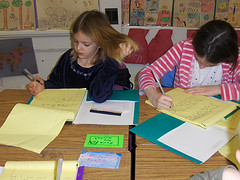
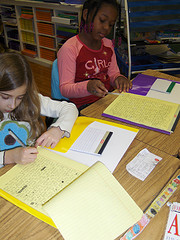
drafting-5One morning last week, I greeted the children and was happy to see them, but I was also preoccupied by all that comes with end of a marking period. I didn’t even realize that I’d forgotten to put the morning assignment on the board. The room was very quiet. I looked up and was amazed. Children had pulled out writing folders. Black ink was moving across smooth yellow legal pads. They were working on drafts started the day before in Writing Workshop. Through writing, they were living a moment, crossing it out, and living it again. They were revising. I’ve been waiting for this. They were not just going through the motions. They were working to get it right.
Today is Ground Hog’s Day and it is also my husband’s birthday. Every year, at his request, we watch Ground Hog’s Day with Bill Murray. Bill Murray plays Phil Connors–a weatherman who is simply going through the motions. He is cynical about his life and bored by the people around him.drafting1 He hates his job and he hates Ground Hog’s Day and he hates the annual assignment of covering the official ground hog, Punxsutawney Phil. Everything is so… predictable. Until one February 2, when it isn’t. He wakes up and is surprised by a blizzard and he is doomed to live that one day over and over again until he finds he can he be surprised by life, too.
drafting-3As he finds meaning in the day that he is living again and again, something happens to the way this weatherman tells the story of Ground Hog’s Day. Poetry works its way into his narrative. As the weatherman finds meaning in the world around him he finds he has something to say — a story to tell. And that he can tell it beautifully.
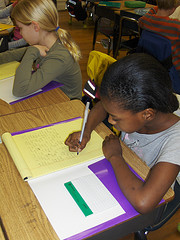
Writing can be our own “Ground Hog’s Day.” Sometimes, through writing, we live a day or a moment again and again–until we get it right. Bill Murray’s weatherman doesn’t see the subtle beauty and joy in the world around him, until he is forced to look again. And again.

As my third graders write, they are looking. When they revise, they aredrafting-4 looking again. Meaning emerges as young writers look, and language gets richer as they see — really see. I saw this last week in Room 204.

Tonight I will watch Ground Hog’s Day again. I used to complain about this. I would complain that watching it once was like watching it again and again. I don’t complain anymore. Bill Murray, as a disillusioned weatherman, has taught me a thing or two. I get it. We have a birthday to celebrate…and so much more.

Posted in Uncategorized | 7 Comments

Grace Trumps Perfection

I wanted it to be perfect. I wanted it to be a day my students would never forget. I wanted the day to be like the Inauguration itself: Big. Wonderful. Groundbreaking. I hunted obstacles down weeks in advance– nothing would get in our way. No reception on the TV? No problem, we’ll get that fixed. The Inauguration scheduled during our lunch? Not a problem. We’ll have pizza delivered.

On January 20, We gathered on the carpet and read The Sweet Smell of Roses, a beautiful book about children who marched with Dr. King.  We talked about the power of words to change our world. We brainstormed words that have inspired change, and can inspire change. I told them that during the Inauguration, they would hear these words and others. “Listen,” I said, “And echo the words that have power for you. Say them out loud.” I wanted my third graders to hear, feel, and know those words. I wanted them to take those words as their own.

I called the Pizza place. They told me that twenty people had called in sick. they had no drivers. The man who answered the phones was making the pizzas himself. It would be hours before he got to our order.

I turned on the TV. It was big. Wonderful. Groundbreaking…until the sound went out.

We went to another classroom. My students randomly, throughout the room, echoed the words they heard as powerful.  I listened to their words as I listened to Elizabeth Alexander’s Inaugural Poem:

We encounter each other in words, words spiny or smooth, whispered or declaimed; words to consider, reconsider.

We went back our room and started on the “commemorative place mats.” Scissors were a blur in a haze of pictures and words and scraps.

We ate dessert first because it was a special day. And because the pizza hadn’t come.

Children cut red, white, and blue paper into strips; put words onto strips; put strips into chains. Word was added to word,  strip was added to strip,  chain was added to chain–longer and longer and longer.  Every word important. Every word adding power to the others. “Like citizens in a democracy,” I told them.

Day was done. Buses called. Children dismissed.

I am always struck by Room 204 in the afternoon. So suddenly still. On this day there was red, white, and blue everywhere. Scraps, like confetti, covered the floor. The parade was gone leaving silence in its wake.

It hadn’t been perfect, but what a big grace-filled day. Big. Wonderful. Groundbreaking.  It wasn’t perfect.  It was just right.

Posted in Uncategorized | 8 Comments

The Power of Words

I love to read Frederick by Leo Leonni to show my students the power of words. The mice are very busy getting ready for the cold dark days of winter. They scurry. They hurry. They work to gather grain. Frederick sits on the old stone wall staring at the sun-drenched field. The outraged mice demand to know why he is isn’t working. Frederick explains that he is working — he is gathering a different kind of food for the winter. Frederick is gathering words and colors. And when the food runs out, he delivers. He helps the mice feel and see that for which they yearn. He uses words to turn the dreams of summer into a winter reality.
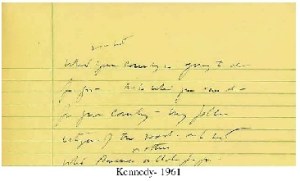
Writers collect and arrange words on scraps of paper, in the margins of books, and in notebooks. Then, one by one, words are picked for their precision, grace, and power.

jfkscrap

John F. Kennedy collected words and phrases. Above is a scrap of paper that he saved. The words he gathered became the words we know: “Ask not what your country can do for you…” In 1961, at his Inauguration, those words stirred hope into action.

On August 28, 1963, Martin Luther King, Jr. gave a speech with a powerful start: “I have a dream.” The dream, the words, and the work of Dr. King changed the world, but not right away.

When Dr. King made his speech, I was an eight year old in the last days of summer. A week later I entered the all white third grade at my all white school in Williamsburg, Virginia. Our schools were segregated. It didn’t seem like anything had happened. Yet.

Forty-five years later, I find myself in a third grade classroom. And what a different classroom it is. We are white and black in Room 204, and we can’t imagine our world any other way.

On Tuesday, we will decorate our desks with red, white, and blue paper chains of powerful words. We will turn on the TV and watch Barack Obama take the oath of office. He will say the words that George Washington said (and every president since):

“I do solemnly swear that I will faithfully execute the office of President of the United States, and will to the best of my ability preserve, protect and defend the Constitution of the United States.”

Then we will listen to our new president’s words, — words chosen carefully for precision, grace, and power, — words for a country and a world on a cold winter’s day in January.

I will be exactly where I want to be: in Room 204 at William Fox Elementary School, where a dream continues to unfold.

Posted in Uncategorized | 3 Comments

Rules of Play

othello-games-002When the rain comes down, the games come out in Room 204 –and I’m amazed at what we learn. Introducing games to my third graders was an intuitive move, but theory and reason weren’t far behind.

I looked for traditional games (no beeping or cartoon characters) with sensible rules of play. Duration was a consideration — Monopoly is a great game, but it takes too long to play in school. And then there’s that ultimate test: would I want to play the game? I can tell you I would rather go to the dentist than play Trouble or Candy Land.

Is there room for playing games in a SOL testing year? There is always room for games that encourage strategic thinking, sustained attention, and quiet social interaction. The class that plays together stays together.

Something else happens as we play Othello, Blokus, Upwards, SET, and Connect 4. We learn how rules work to make the game fun. It doesn’t take children long to see that if one person doesn’t follow the rules, it is unfair to the others in the game. Hmmm…”Rules and laws protect the rights of others…” Wait! That’s an SOL!

We play cards, too — as Shakespeare probably did. Card games were big in Elizabethan times. You can still see a touch of the English Renaissance if you look at the knave (I mean jack) in a deck of cards. Recently, Mr. Jefferson (Kemonte’s dad) taught us a fun and fast card game. I am sure your child would love to teach it to you.

There are conventions to be learned in playing a game: winning and losing gracefully; taking turns; and caring for the materials, so others might enjoy them. If you ignore the rules of play, meaning breaks down and chaos ensues.

There are conventions in writing, too. Punctuation existed before Shakespeare, but he took it to a new level. Shakespeare used punctuation to make sure his words were read the right way. Punctuation locks voice in place. It is powerful for a young writer to learn that punctuation is not a mystery that belongs to teachers –it is a tool, and it belongs to the writer. It’s the secret handshake. Punctuation marks are simply rules of play. Like games, they can be a lot of fun.

And what about you? What is your favorite punctuation mark? What is your favorite game? Share it with a child. Share it here. It’s your move.

Posted in Uncategorized | 32 Comments

Let Us Imagine…

shakespeare11A few days ago, I was sitting in a dentist’s chair furtively reading a biography of William Shakespeare. I was embarrassed when the assistant noticed. Who reads about Shakespeare in a dentist’s office on Winter Break? She went on to talk about her own love of this great English playwright and poet. She told me she had a teacher in her senior year of high school (1997) who opened up the world of Shakespeare for her.

Our enthusiastic conversation confirmed what I already knew: the difference between people who love Shakespeare and people who don’t… is a teacher. It was true for me. In the eighth grade, my English teacher was a British-born Israeli named Judith Morcades. It was her contagious love of Shakespeare that gave me my membership into the “Shakespeare Club.” Because of teachers like Ms. Morcades, Shakespeare is not intimidating; Shakespeare is joy.

Stephan Greenblatt, a Shakespeare scholar at Harvard, begins his wonderful award-winning book, Will in the World, with these words, “Let us imagine…” I love this. Shakespeare scholars work with a finite number of facts. The facts are arranged and rearranged and gently folded into informed imagination. This is how we recover, rebuild, and restore Shakespeare’s world to better understand the man who wrote the plays.

I lead into Shakespeare with an economics unit. We’ll start before Shakespeare was born. In the hustle and bustle of Medieval trade on London Bridge, at the Market Fair that Chaucer’s pilgrims might have seen at Canterbury Cathedral, and at a Medieval Feast like the one that might have been prepared at Macbeth’s castle, we’ll learn the vocabulary of economics.

We will read the folktales that Shakespeare might have heard and we’ll recite the street rhymes of tradesmen that Shakespeare might have known by heart. We’ll sing songs that he may have sung, and dance to music to which he might have danced. We’ll research his theater, his clothes, his food. We will get to know the characters in his plays, and then we will be the characters in his plays. We will imagine his life.. Shakespeare would forgive us this. He was all about the imagination. His theater, The Globe, was a treasure house for the imagination.

Every now and then a scholar hypothesizes that Shakespeare did not write the plays we think he did. I’ve read the theories, but for my purposes the plays were written by the son of a glover who was known to his friends as Will. That’s my story and I’m sticking to it.

This is the best way I know to invite my students into the Shakespeare Club.. You come, too. Let us imagine..

Posted in Uncategorized | 10 Comments

Remembering in the Present Tense

I loved reading the homework last week. I loved reading about visits to the food bank to deliver food; visits to the emergency room to deliver books; and visits to neighbors to deliver cookies. I loved reading about (and tasting) your family traditions. I noticed that as children remembered on paper (the work of memoir) the things they did, they tucked in so many of our writing lessons. They were alliterative, they compared, they listed, they painted pictures with words, and they were precise. They wrote as writers.

I also loved reading the comments on this blog. My niece commented last week (very flattering to an aunt). I’d written about the tradition of baking cookies with my paternal grandmother. She wrote about a tradition with her grandmother, my mother. My mother makes Antipasto every year. As with many edible traditions, there is a story behind it. She wrote the story down ten years ago:

Christmas Antipasto
Mother and I spent Christmas of 1953 together in her new house in Honolulu. My main memory of that Christmas season is of Jasper and Izzy Holmes’ annual cocktail party in their house at 6 Blackpoint Road, the very house that we had rented 20 years earlier when I was five, and which I remembered very well. Mother, who loved any party, was particularly excited about this one–an annual event for which Izzy produced her special antipasto in great quantity. Mother told me that she had tried in every way she could think of to get Izzy to share the recipe, but Izzy always refused. Mother was not ordinarily a “food” person, so I knew this must be an extraordinary delicacy. Indeed, it was unlike any other hors d’oeuvre I’d had before, and it was delicious.

Time and a half went by, and Mother, who returned permanently to the mainland in 1956 to be nearer her children and baby granddaughter, settled into an apartment in the building next to us in the Donna Lee complex at Bailey’s Crossroads. She had with her Izzy’s recipe for antipasto. “How did you get it?” I exclaimed with wonder. “On pain of death, if I ever breathed it to a soul,” she replied. It wasn’t very hard for me to get it out of her, and I entered it into a woman’s club cookbook, so that I would always know where to find it.

IZZY’S ANTIPASTO
Serve with crackers or on lettuce

1/2 cup catsup
2 small cans flat anchovies
1/2 cup olive oil
1 can tomato sauce
1/2 cup dry white wine
1/4 cup white wine vinegar
2 cloves garlic
1 jar pickled onions
1 small can sliced mushrooms
1/2 cup slightly cooked carrots
1/2 cup thinly sliced cooked celery
1 cup diced sweet pickles (mixed)
1 cup slightly cooked cauliflower pieces
1 can pitted ripe olives, sliced or diced
1 jar stuffed green olives, sliced
1 small jar tiny artichoke hearts, optional
2 cans solid white tuna
1/4 cup capers
l tsp. salt
1/4 tsp black pepper
1 tsp chili powder
1 bay leaf
Few drops Tabasco
Few dashes Worcester or soy sauce

In large skillet stir catsup, olive oil, tomato sauce, vinegar,
wine, and bay leaf. Cut anchovies in half and add with their
oil. Press peeled garlic and add. Bring to boil and boil for 2
minutes on medium heat, stirring a bit. Remove from fire and add seasoning a little at a time, testing to our own palate. Drain and discard liquids from other ingredients. Toss together and blend with sauce. Check seasoning, bring to boil and remove immediately from fire, and cool. Store in refrigerator in jars.
Makes 4-1/2 pints.

Marcel Proust took a bite out of cookie and remembered everything he ever did. Okay, that is really over simplifying Remembrance of Things Past— and it wasn’t a cookie, it was a madeleine–but it shows how taste can transport us. In Proustian time, the past pervades the present in an instant with a tiny taste of a childhood treat. I know it will happen for me with antipasto on a cracker before Christmas dinner. It always does.

Posted in Uncategorized | Leave a comment

What We Really Want…

christmascookiesWhat do you really want for Christmas? What are you hoping for during Hanukkah? These are the questions that children hear at this time of year. And so do we. These sound like simple questions, and they are. Too simple. Can everything we want be put in a box, wrapped, and placed under a tree? No matter what our religious tradition is, gift giving has a grace of its own. And some gifts are intangible.

I love holidays. I especially love holidays where jolly, merry, happy, lights, festival, and cheer end up on vocabulary lists. We are invited to be our best selves as family members and friends. We mix story, tradition, and symbol as we rush to get ready and then we stand back and wait. There are some things we can’t make happen– but we prepare a place in ourselves, on our calendars, and in our homes so something CAN happen. What is it we want? What are we waiting for?

Jo Robinson and Jean Coppock Staeheli researched what children really want their book Unplug the Christmas Machine. They found that children want:

  • Reliable traditions
  • Realistic expectations about gifts
  • An even pace
  • RELAXED time with parents

Traditions are like hall closets–they can get out of control and need to be sorted through from time to time. The useful and meaningful need to be kept in a “SAVE” pile. Others may need to be mended, amended, or put in deep storage. One of my most meaningful traditions is making my grandmother’s Christmas Cookies: shortbread cut-out Christmas trees iced with pale green frosting and sprinkles. My family counts on them. This morning I taught my four year old granddaughter to roll out the dough, just like my grandmother taught me. I got out my Christmas Tree cookie cutter. She said, “Can we make stars instead?”

It sounded like a good idea to me. With my grandmother’s recipe, we made shortbread cut-out stars with pale yellow frosting. And we both got what we really wanted.

May you and your children have plenty of what you want most together this holiday season!

Posted in Uncategorized | 8 Comments

Puzzling Over Standardized Tests

As a child, I often watched my mother or grandmother sit down at the dining room table with an ashtray, a cup of coffee, and a pen. The morning paper had been read and it was time for the crossword puzzle. I didn’t understand the clues and I didn’t know the answers, but that didn’t matter. I knew I was a citizen in the world of words and that one day this ritual, along with a taste for black coffee, would be mine. Even then I liked being part of a puzzler’s smart meditative silence.

When I grew up I reached for the back page of the Style Section of the Washington Post. I was shocked (and somewhat humiliated) to find that I couldn’t do it. At the beach, I saw that my brother’s wife, Debbi, knew just what to do. I watched her glide into the familial Zen-like zone of the crossword puzzle. How?

“I don’t get it. I can’t do it.”

“Of course you can do it. You just need to know how it works.”

She was right. I had the background knowledge, but I wasn’t puzzle-savvy. I needed to be clued in about clues.

I start teaching reading comprehension on the first day of school with a deceptively simple shared inquiry technique: “No Answers, Just Questions.” This is low risk high yield activity for students. I tell a folk tale. At the end, each child is invited to ask a question—no answers allowed! We quickly learn that the best questions have more than one right answer.

But later we learn that on a standardized test — as in a crossword puzzle — there is only one right answer, no matter how good the question.

This concept is a hard pill for some deep thinking readers to swallow. Confronted with a practice test, hands go up: “I can’t do it. I don’t get it.”

“As smart as you are? As hard as you’ve worked? Of course you can do it. You just need to know how it works.”

This week in Reading Workshop we will begin a study of fables. We will also begin a unit of study on Question and Answer relationships (QAR). We will work cooperatively to learn how to think analytically without over-thinking; we’ll build our stamina and hone our skills.

Every year June rolls around and so does state testing. My children know that when it comes to SOL’s they will do “S.O. Well.” Part of scholarship is an ability to show what you know. Clued in about clues, third graders will pick up their pencils with alacrity–an eight-letter word that means ‘cheerful readiness.’

And now I have a pen, a cup of coffee, and a crossword puzzle waiting for me.

Posted in Uncategorized | 1 Comment