The poetry in our life can be coy. It hides and waits to be found. It demands that we have world enough and time enough to look. It can be found in the leafy green of the trees now that April’s here. It can be found trembling leaves when the wind is passing through. It can be seen in the face of the moon as it stares in the air in a nighttime game of hide and seek. Poetry gives us words for those moments that take us by surprise.
Poetry can be found in moments of celebration. I saw it on Saturday at the Bat Mitzvah of a former student. I heard poetry in her luminous reading of the Torah, and I heard it as she sang words that rang though the sanctuary. I saw it in the awed faces of her classmates, many of whom were second graders with her in Room 204. I saw poetry in the joy of her parents. “Remember?” her mother asked me. I smiled. Yes, I remember.
Later on Saturday, I saw poetry in purple frosted cupcakes on a picnic bench in the park. I heard poetry as we sang Happy Birthday to my one year old granddaughter. I felt poetry as we joined hands in a circle. I heard poetry in my son’s prayer of Thanksgiving even as his first birthday replayed in my head. I saw it in the two ducks who came to join us and I heard it in my daughter in law’s greeting: “Oh, look… Mr. and Mrs. Mallard are here…” Some days are so special that poetry does not even bother to hide.
The third graders in Room 204 are experts at finding poetry. And we love to find it in one of its favorite hiding places; we hunt for poetry in prose. We note metaphor, personification, simile, alliteration, and internal rhyme. These terms are not important for third graders to know (and they are not on the SOL’s), but they have evolved naturally through conversation. We don’t learn them by definition– we just name these poetic elements as we uncover them in prose.
We now know to look.
Ode To Poetry in Prose
By Annie Campbell
Poetry I’ve seen you hide
In slow moving herds of words
Ever cleverly disguised.
Camouflaged in rows of prose
You roam on the loose-
Popping up where you choose–
Until I chance upon you.
Poetry I’ve seen you hide.
Stitched in the friction
Of old and new
Pictures and feelings,
You blaze into the song of talk.
You get me again and again
Yet now I know to look.
 Where have you found poetry?
 Life is poetry.


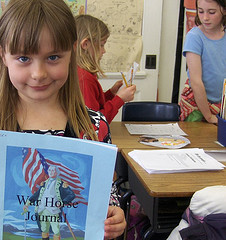 They came into Room 204 one by one on Friday. They came on poster board, on canvas, on construction paper, and on parchment. They came in collage, in acrylic, in marker, in crayon. They spoke through letters, through quotes, and through bits of speeches. One even spoke from the horse’s mouth. Their personalities took shape through poetry, storied sketch, comic strip, time line, and through props: a tall black hat, a bible, a walking stick. They came into Room 204 one by one on Friday: George Washington. Thomas Jefferson. Abraham Lincoln. Thurgood Marshall. Rosa Parks. Dr. Martin Luther King, Jr.
 I was skeptical. This year I decided to teach memoir for the first time. I wondered if it would work.
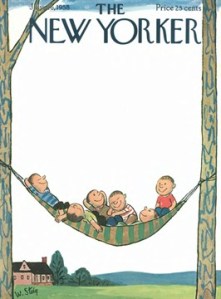 Just over a week ago the snow melted into daffodils. My husband and I took advantage of the springlike day and walked to Millie’s for brunch. A young couple sat next to us and read The New Yorker. Each had a copy of the current issue, a clue that they were dating and not married. (Otherwise they would have just one copy.) A conversation was inevitable; I can’t resist finding out why people read what they read. And I’d been thinking about The New Yorker as I taught memoir to my third graders. My own understanding of memoir has been shaped by that magazine.
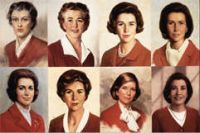 I recognized the red dress with its prim white collar right away. I’d seen her on the Bisquick box a hundred times. I was five when I spotted Betty Crocker in the snack bar on an Army base in Germany.
 We are learning that memoir is the story of a moment– a moment that begins with a scrap of memory. My memoir begins with a scrap of green fabric with a tiny white design.
 Write Now. Write Here.